Tags.

The Renault Koleos – It’ll Grow On You

The Renault Koleos

I must say, I was pleased to be at the launch of the Renault Koleos when I was up in Scotland.  However, I found the looks of the thing uninspiring, whilst the massive size and sheer bulk put me off.  I have now come around though, to believing that it has a certain Gallic charm all of its’ own.  Granted, you might not agree – but just remember exactly what I thought earlier on.

So why might you like it?  Well, it’s a four by four (4×4) crossover.  That means lower fuel consumption than a standard four wheel drive off roader, whilst also having the good looks of a more sports oriented vehicle.  Does it live up to the brief?  Well, I’m not so sure about that.  To be honest, it’s a bit more luxury than your standard crossover – dare I say it, in this land of almost-recession, a little bit of luxury.

Here are some of the features that make it stand out from the crowd:

* Segment leading visibility, forward field of vision and rear
* Best in-category interior modularity with a Super-Fold system to make sure the space is versatile
* Soft leather seats
* Top of the range Bose sound system
* A 450 litre boot space with ski holding placement system
* ESP and Brake Assist
* All mode 4×4 i system for maximum control
* Panoramic transparent sunroof
* Sat nav with full colour mapping system
* Soundproofing and acoustic windscreen
* Bi-xenon headlamps and cornering headlights with washers
* Front(!) and rear parking sensors

Take a good look at that list.  How many of those does your car have?  I’ll tell you about how it matches with mine – I have none of those luxuries.  Again, an odd fit in these times.  Therefore, I have a strong feeling that yummy mummies the land over will love this.  That is, if they can accept a new ugly child into their family.  However, once you’re in there, it’s likely to be a place you’re perfectly happy to be in.  It’ll cocoon you like few other cars.

The Koleos is available with the strong Dynamique dCi 150 engine emitting 191 CO2(g/km).  Fuel consumption is average at 34mpg and it has an on the road price new of around £18,000.  More information is available at the official Renault site.

Mr Butterscotch

Posted by: Mr Butterscotch

Renault Laguna GT

The Renault Laguna GT.

GT cars are wonderful in theory. If you’re not sure what I’m talking about, I’m referring to Grand Touring vehicles. These are the vehicles that should be able to move you across the countries of Europe with little problem, plenty of comfort and even more style. Alongside this, a GT car should be quick. Really quite quick. After all, you don’t want to get stuck in rural France now do you?

Renault isn’t known normally for GT cars - you could say that’s a shame given that the Laguna GT looks really quite good. Granted, it is perhaps still too mundane for some (if you’ve seen the Alfa Romeo Blackline GT you’ll know what I mean) but nonetheless, the front-end redesign looks stylish and the car has some decent curves.

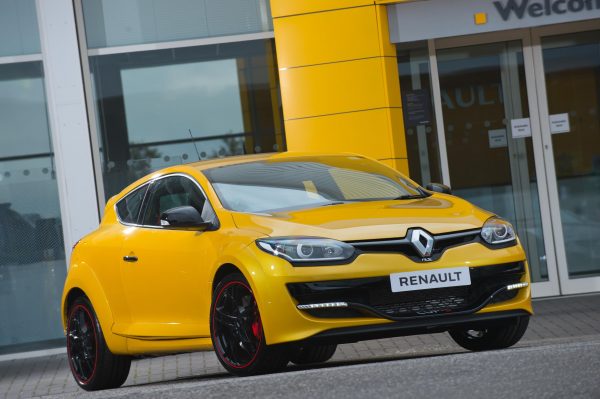
Fitting into the family saloon segment of the market, the standard Renault Laguna is a car that is really rather dull - that makes it a break away for the company that brings such bizarre designs as the Megane (the only car with a big arse) and the Twingo - the F1 styled variety of which I’m keen to have a go of. So can this lowly start really provide something you’ll be desperate to drive?

Where It Stands

The GT offering is the absolute top of the range for both the tourer (estate body type) and the hatchback (though similarly to the Vauxhall Vectra, it looks more like a saloon than a hatch). Naturally as it is at the top of the tree you’ll get a lot more extra kit for your money. Whether it’s truly worth it depends on what you want.

The Look
Externally, there’s a much larger black mesh front grill to provide a more menacing look. The headlights stand out a lot more with this look, whilst the eighteen-inch alloys are one of the standout features of the car. They really do make a different to the look and feel. Darkened rear lights, twinned chrome exhausts and lots of GT badges round off the look of the car.

Inside
It is really the internals however of the car that will sell it to you (if you’re going to buy). It is just as good (luckily) as the standard Laguna, with added styling in the shape of two tone leather seats and alcantara sports seats that’ll hug you nicely as you’re driving down to Dover. There’s also a three spoke steering wheel that is flat bottomed in true racing style - just another touch that makes the car a little bit special.

Driving Dynamics
But what’s actually changed when moving from a boring saloon/hatch/estate to something a bit more involving like a GT car? I’m always sceptical about a current car being made into a GT, but luckily the Laguna doesn’t disappoint. Renault has used their much-acclaimed Active Drive four-wheel-steering system on the chassis to create a much more involved driving experience. The science behind this is simple but the level of control is much improved - essentially all four wheels will turn, instead of just the front two. You’ll like it a lot.

Performance

A GT badge, as mentioned, should always mean a bit more power. In this regard, the Laguna is no slouch (it’s hardly a supercar either mind you). The time of 0-60 in 7.8 seconds is very reasonable for the petrol, along with a 145mph top speed. These figures are for the 2.0 litre turbo, however you could opt for the diesel that should give you closer to 40mph and similar power.

And Finally…
With the coming of May seeing this car going on general release, it looks like we’re in for a GT time for Spring. Prices start from a not inconceivable £21,050 for the Petrol.

Mr Butterscotch

Posted by: Mr Butterscotch

Five Cars That Are Cheap To Insure

The Ford Fiesta.

I’ve made no bones about my passion - and that tends to be fast cars.  You may have even gotten a little sick of hearing Lamborghini this or Aston Martin that.  You’ll no doubt be shouting at the screen - much as many do with Top Gear - and saying ‘where are the normal car reviews?’

Well, I’m not about to review the new Kia Picanto for you (even if it is a good car).  Well, I will if I get an invite to test-drive it.  In the meantime though, what I’d like to do is recommend five cars that you’ll love.  You’ll love them because not only are they on the whole very decent at what they do, but also they’ll save you a fortune in insurance.

Whether you’re a new driver or an older person looking to save money, any of these cars will be suitable for you.  Even if you’re the motorist looking to save a few bob, then you won’t go wrong with these.  This is not least because not only are these cars cheap to insure, but they all have relatively small (and economical) engines.  So, without further ado, let’s take a look at the five.

Skoda Fabia
Don’t listen to those who are still telling the same old badge jokes.  In fact, poke them in the eye and tell them they are about ten years behind the times.  Since VW took over Skoda way back in 1991, things have got better and better.  The Fabia is based on the V Polo and is extremely reliable, hardwearing and very safe.  The 1.2 litre Classic is insurance group one - that fact will certainly make your wallet fatter.

Renault Clio
The third generation of the supermini is a modern classic in many ways and the quality certainly goes some way to explaining why you see them just about everywhere.  The way in which the internal space is handled is very clever, meaning that there’s actually quite a bit of room inside.  Going for the 1.2 litre will see you getting almost 50mpg, something that you won’t see from many other engines.

Nissan Micra
Granted, this car will probably be the least popular in this review.  Why is that?  Well, the perky little car is what a huge number of people learn to drive in every year.  Given this fact, I know that I for sure was desperate to distance myself from the Micra - even if my ideal car is a Nissan (a 350Z for the record).  However, the modern Micra is actually a damn good car.  You’ll get keyless entry, parking sensors, air con and many other perks you wouldn’t necessarily expect.  Overall, it’s a really good car and it won’t cost the Earth to run.

Fiat Punto
There is a large number of this particular Italian supermini on the road and for good reason.  It enjoys being revved.  It really is that simple.  Much like James May said in his review of the Fiat 500, these Italian cars are made to be lit up by pushing the revometer until the valves have “jumped up and are dancing on the bonnet”.  I couldn’t agree more - and it is one of the more involving cars here.  Not only that, but even the 1.3 litre sporting will see you managing to get very reasonable insurance quotes.

Ford Fiesta
This is a car that has been around for about 30 years now - which must tell you something.  Granted, there are so many superminis out there now that the Fiesta can look a bit of an oldie (not least because the design has never really been altered that much) but it is a testament to the quality that so many are still going.  The newer and younger models however are really geared for the modern generation and feature such additions as Bluetooth and new-design alloys.  Why get it?  Well the 1.25 litre version is a group two and will give you about 45mpg.  You can chuck it in corners and it’ll give you a smile.  With that in mind, what’s not to love?

Conclusion
You’ll have seen that there’s a trend in these ‘cheap to insure’ cars - and that is the fact that they are pretty much exclusively superminis with small engines.  There’s nothing wrong with that, in fact they can offer a great drive along with frugal performance.  So, for a change, let’s all hail these little metal marvels of money saving.  Make mine a Fabia (VRS edition diesel mind you).

Mr Butterscotch

Posted by: Mr Butterscotch